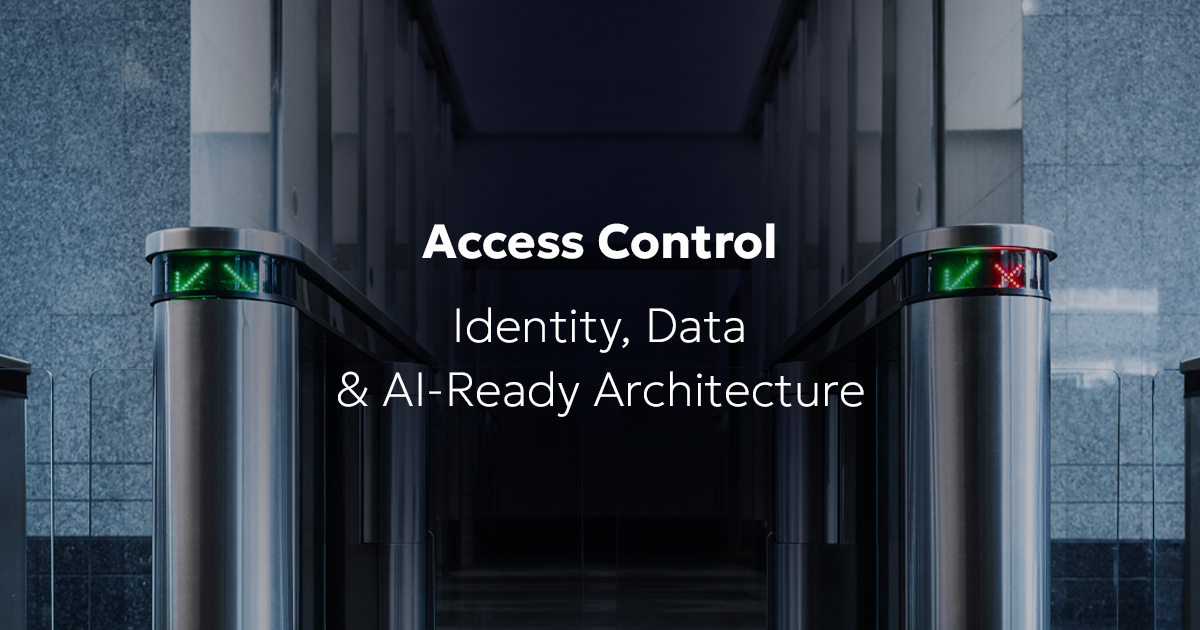
For decades, organisations viewed access control mainly as a matter of technological infrastructure, such as controllers, readers, credentials, and doors. Today, however, the real operational risk does not appear at the entrance. It lies in identity.
In other words, it concerns who a person is, what role they hold at any given moment, and how an organization can prove this consistently and accurately. This applies at every point in time and across every location. In this context, identity driven access control takes on a central role.
Why identity now sits at the center of access control
Organizations intensify this challenge as they grow and increase their operational complexity. At the same time, mergers, acquisitions, international operations, and distributed teams often create environments with multiple access control systems. In addition, they apply different management processes and handle fragmented data.
These conditions cause delays, human error, incorrect access decisions, and increased compliance risk.
Transitioning to an identity centric access management model
The shift to an identity centric model fundamentally changes this logic. Instead of basing management on the available system, organizations now place the individual at the center.
Identity serves as a single point of reference, on which organizations apply policies, roles, and lifecycle changes in a consistent and repeatable way. This forms the core of Physical Identity and Access Management, or PIAM, which standardizes daily operations through data and processes rather than relying on individual experience.
The role of Artificial Intelligence in modern security
In this context, Artificial Intelligence does not simply enhance security systems. Instead, it naturally evolves an environment that organizations have already structured correctly.
Only when identity remains clear, unified, and trustworthy can organizations leverage advanced technologies to achieve full oversight and security through a single, flexible protection solution.
AMAG’s direction and the identity first approach
AMAG Technology sets a direction that reflects this philosophy precisely. With an identity first approach and tools such as Symmetry CONNECT 2.0, organizations systematize the complete recording of movements, especially in environments with multiple access control systems.
At the same time, they retain their existing equipment and modernize its operations gradually. They do so without requiring a radical replacement of infrastructure.
The message is clear:
Artificial Intelligence in access control does not start with algorithms. It starts with identity.
Organizations that invest today in identity driven architecture do not only solve their current problems. At the same time, they build a future in which security becomes more intelligent, data driven, manageable, and inherently connected to business operations.